
Ford Transit vs Mercedes Sprinter: which writes off better?
2026 model year · checked November 2026


Both qualify. Every Transit and Sprinter we checked is over 6,000 lbs GVWR, and neither has the $32,000 SUV cap, so the full business-use cost can go to Section 179. The tax treatment is the same, so the write-off follows the price.
Both cargo vans are rated far above 6,000 lbs, and a cargo van with no seating behind the driver isn't treated as an SUV, so neither has the $32,000 cap: the full business-use cost can go to Section 179. Passenger versions follow different rules, so check before you add rear seats.
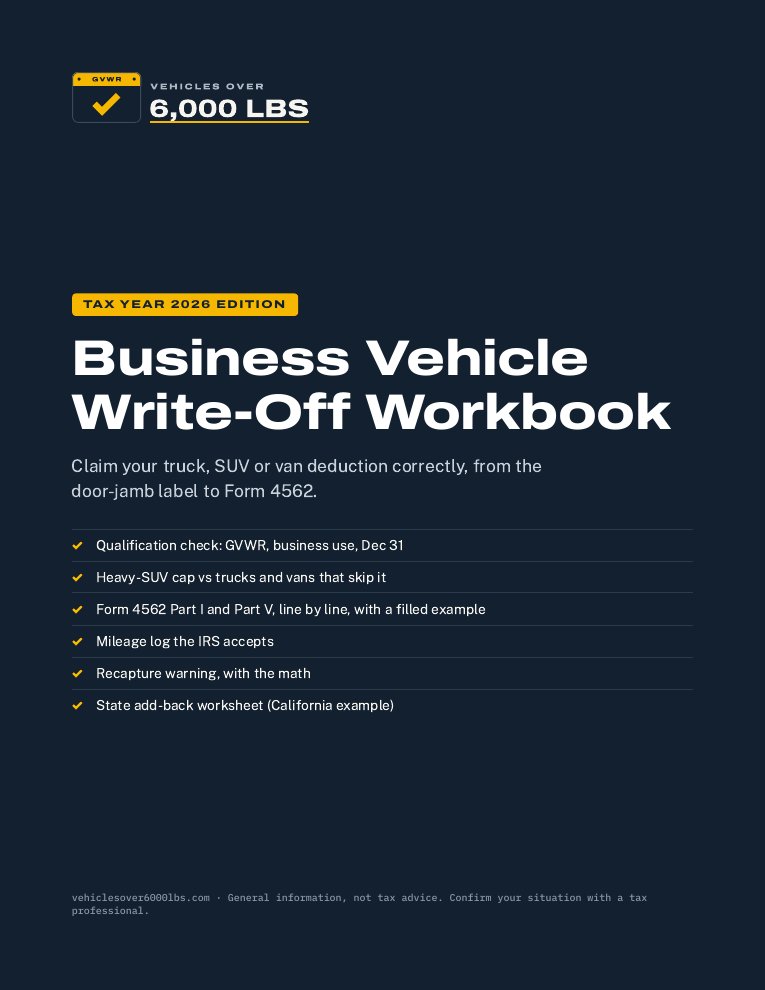
Whichever you pick, the deduction only holds with over 50% business use on a mileage log, and it has to land on the right Form 4562 line.
Qualifying is step 1. Claiming it right on Form 4562 is step 2. The 6,000 lb Write-Off Kit takes you from the door label to a finished Form 4562 in one evening, with a calculator and a filled example for your kind of vehicle.
Transit vs Sprinter: the Section 179 numbers side by side
| Transit | Sprinter | |
|---|---|---|
| Type | Cargo van | Cargo van |
| GVWR | 8,800 to 9,500 lbs | 9,050 to 11,030 lbs |
| 6,000 lbs test | Qualifies | Qualifies |
| Lightest trim vs the line | +2,800 lbs | +3,050 lbs |
| $32,000 SUV cap on Section 179 | No (cargo van) | No (cargo van) |
| Price from | $53,700 | – |
| Example price | $55,000 | $65,000 |
| Year-one deduction80% business use, 100% bonus | $44,000 | $52,000 |
| Year-one deduction, no bonuselected out, or a state that drops bonus | $44,000 | $52,000 |
| Tax saved in year oneat a 32% rate | $14,080 | $16,640 |
| Cost after year-one tax savings | $40,920 | $48,360 |
Example prices are illustrative mid-trim prices; deductions assume a trim over 6,000 lbs. Tax saved = deduction × 32%. Your numbers: Transit calculator · Sprinter calculator.
Which one writes off more in 2026?
Price drives the deduction. At typical prices ($55,000 for the Transit, $65,000 for the Sprinter), the Sprinter deducts $8,000 more in year one with bonus, because you spend $10,000 more. After the tax savings the Transit still costs about $7,440 less. A bigger write-off is never a reason on its own to buy the pricier vehicle.
Neither has the SUV cap. The full business-use cost can go to Section 179 on both, with or without bonus depreciation. That makes either one a strong pick in states that keep Section 179 but drop bonus.
Both clear the weight test with room to spare. The lightest trim in the pair is the Transit at 8,800 lbs, 2,800 lbs over the line.
Transit: $55,000, 80% business use.
| Business-use cost | $44,000 |
| Section 179 | $44,000 |
| 100% bonus on the rest | $0 |
| Year-one deduction | $44,000 |
Tax saved at 32%: about $14,080. Without bonus: $44,000 in year one.
Sprinter: $65,000, 80% business use.
| Business-use cost | $52,000 |
| Section 179 | $52,000 |
| 100% bonus on the rest | $0 |
| Year-one deduction | $52,000 |
Tax saved at 32%: about $16,640. Without bonus: $52,000 in year one.
Pick the Transit or the Sprinter?
Pick the Transit if…
- You want AWD at a lower price (Transit cargo AWD from $53,700)
- You want the T-350 medium roof (9,500 lbs)
Pick the Sprinter if…
- You need the most capacity: 3500XD cargo up to 11,030 lbs GVWR
- You want the Sprinter's range of lengths and roof heights
GVWR by trim: Transit vs Sprinter
2026 Ford Transit
| Trim | Drive | GVWR | 6,000 lbs test |
|---|---|---|---|
| T-150 cargo, 148 in low roof | AWD | 8,800 lbs | Qualifies |
| T-350 cargo, 148 in medium roof | AWD | 9,500 lbs | Qualifies |
2026 Mercedes Sprinter
| Trim | Drive | GVWR | 6,000 lbs test |
|---|---|---|---|
| 2500 cargo, 144 in / 170 in | RWD | 9,050 lbs | Qualifies |
| 3500 cargo | RWD | 9,990 lbs | Qualifies |
| 3500XD cargo | RWD / AWD | 11,030 lbs | Qualifies |
The black line on each bar is 6,000 lbs. GVWR changes with trim, drivetrain, cab, bed and options; the label on the driver's door of the vehicle you buy is the final word. Sources at the bottom of this page.
The other two tests (same for both)
Pass all three and you can likely deduct most or all of the business-use cost this year. Drop to 50% business use or less in a later year and some of it comes back as income (recapture). Read the full Section 179 vehicle guide →
More Section 179 comparisons
 VS

All comparisons · GVWR lookup for every model · Vehicles over 6,000 lbs
QUESTIONTransit or Sprinter: which is better for Section 179?▾
Both qualify. Every Transit and Sprinter we checked is over 6,000 lbs GVWR, and neither has the $32,000 SUV cap, so the full business-use cost can go to Section 179. The tax treatment is the same, so the write-off follows the price.
QUESTIONAre the Transit and Sprinter both over 6,000 lbs?▾
2026 Ford Transit: 8,800 to 9,500 lbs GVWR, so every trim we checked passes. 2026 Mercedes Sprinter: 9,050 to 11,030 lbs GVWR, so every trim we checked passes. The IRS test uses GVWR (on the driver's door label), not curb weight.
QUESTIONDoes the $32,000 SUV cap apply to the Transit and Sprinter?▾
Ford Transit: no cap (cargo van). Mercedes Sprinter: no cap (cargo van). The cap limits Section 179 only. With 100% bonus depreciation for vehicles acquired after January 19, 2025, it rarely changes the federal year-one total.
QUESTIONHow much can I write off on a Transit vs a Sprinter in 2026?▾
At 80% business use, a $55,000 Transit about $44,000 and a $65,000 Sprinter about $52,000 in year one. Either way you need over 50% business use, proved with a mileage log, and the vehicle in service by December 31, 2026.
QUESTIONDoes a passenger van skip the SUV cap too?▾
Only in some cases. A van that seats more than 9 people behind the driver's seat skips the $32,000 cap. A crew van with one or two rear rows usually doesn't: it's treated like an SUV for Section 179, though bonus depreciation can still cover the rest.
Transit or Sprinter: either way, claim it correctly.
Most owners get the deduction wrong in one of three places: no mileage log, the wrong Form 4562 line, or a missed state add-back. Pick your next step.
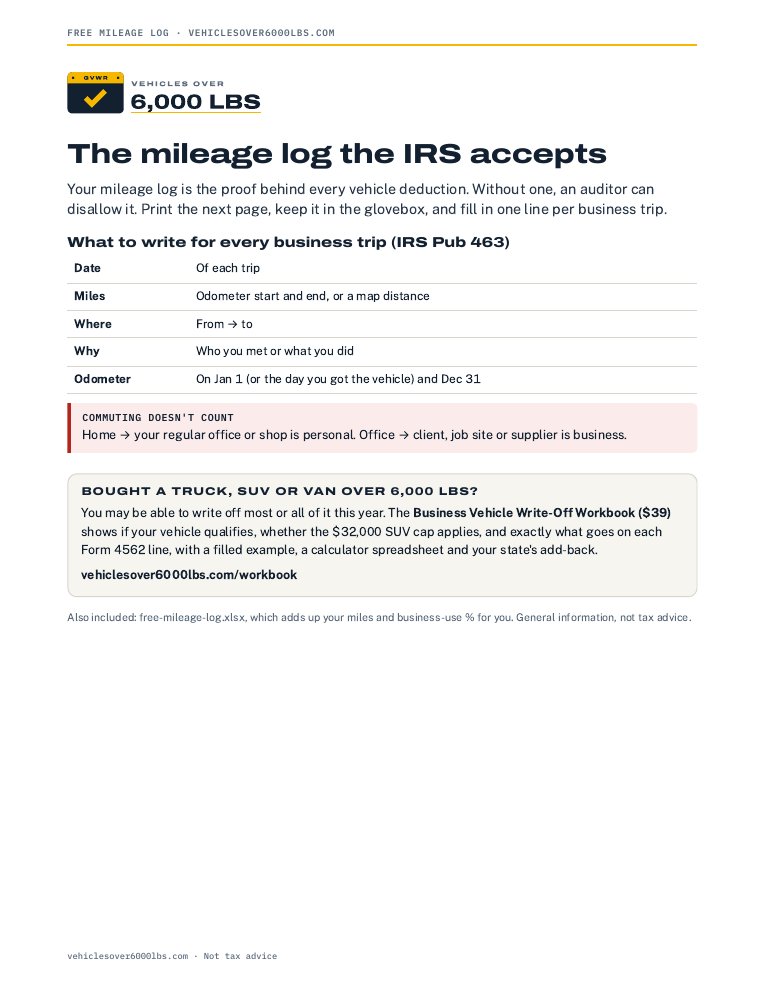
- Printable log + spreadsheet
- Calculates your business-use %
- Form 4562 walkthrough
- Calculator + state add-back
- Your year-one number in 5 minutes, from the calculator
- Form 4562 filled in for an SUV, a pickup and a van
- Workbook: qualification, SUV cap, recapture, state add-back
- Dec 31 Dealer Kit, with the dealer email
- CPA Handoff Sheet + Catch-Up Log Kit
- Founding Buyer: every future edition free
Instant download · Refund any time until April 15, 2027 · See everything in the kit