The three tests
Pass all three and the luxury-auto caps that limit regular cars don't apply. Fail the first and you're capped at $20,300 in year one. Fail the second and you get no Section 179 and no bonus at all.
How much you can deduct in 2026
| Section 179 overall limit | $2,560,000 |
| Phase-out starts (total equipment bought in the year) | $4,090,000 |
| Heavy SUV cap on Section 179 | $32,000 |
| Bonus depreciation, acquired after January 19, 2025 | 100% |
The 2025 tax law made 100% bonus depreciation permanent for property acquired after January 19, 2025. Bonus has no dollar cap and no income limit, so it picks up whatever Section 179 doesn't. For most owners that means the whole business-use cost in year one.
Example: $90,000 SUV, 85% business use, delivered December 12, 2026.
| Business-use cost ($90,000 × 85%) | $76,500 |
| Section 179 (SUV cap) | $32,000 |
| 100% bonus on the rest | $44,500 |
| Year-one deduction | $76,500 |
The $32,000 SUV cap, and who skips it
The cap applies to SUVs rated over 6,000 and up to 14,000 lbs GVWR. It caps Section 179 only, not bonus. Pickups and vans can skip it if they meet one of these design tests (IRC 179(b)(5)):
- Pickup with an open bed of at least 6 ft (interior length) that isn't easily reached from the cab. Most crew-cab short beds (5.5 to 5.8 ft) don't pass and are capped.
- Cargo van with no seating behind the driver's row and no body section sticking out more than 30 inches in front of the windshield.
- Seating for more than 9 people behind the driver's seat (large passenger vans).
Why it still matters with 100% bonus: if you elect out of bonus, or file in a state that doesn't allow bonus, the cap decides how much you deduct this year. Compare: F-250 (6.75 ft bed, no cap) vs F-150 SuperCrew 5.5 ft (capped).
If your vehicle is 6,000 lbs or less
It's a "passenger automobile" and Section 280F caps depreciation, whatever the price. For vehicles placed in service in 2026:
| Year 1 (with bonus) | $20,300 |
| Year 1 (no bonus) | $12,300 |
| Year 2 | $19,800 |
| Year 3 | $11,900 |
| Each later year | $7,160 |
These are reduced by your business-use %. Close calls are common: the Ford Explorer is 5,770 to 6,150 lbs depending on trim. Check before you buy.
Business use and the mileage log
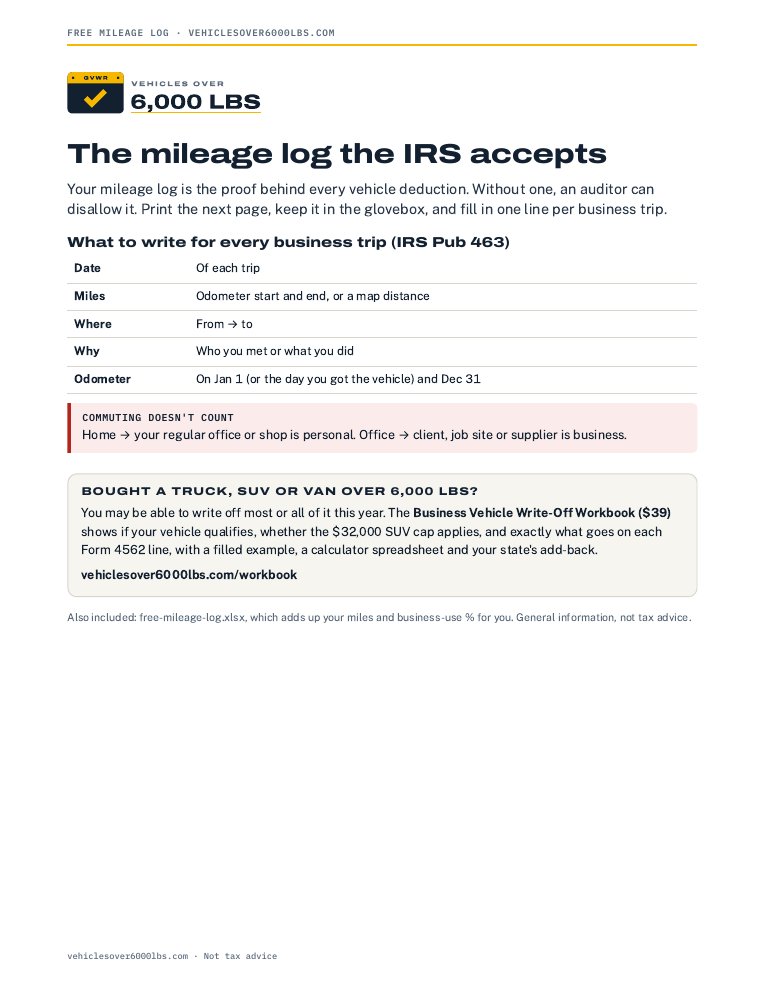
Vehicles are "listed property", so the IRS wants written proof of how you used them: date, miles, destination and business purpose for each trip, plus total miles for the year (Publication 463). Commuting from home to your regular workplace is personal.
The test runs every year for the recovery period, not just year one. If you can't prove over 50%, the deduction goes. A log kept as you go is far stronger than one rebuilt at tax time. Get the free mileage log. Weighing the standard mileage rate instead? Mileage rate vs Section 179.
Financing it? For a self-employed owner, the business share of the loan interest is a business expense too. The separate car loan interest deduction (up to $10,000 a year) is for vehicles used mostly for personal driving.
Placed in service by December 31
"Placed in service" means the vehicle is delivered and ready to use in your business. A signed contract, a deposit or a vehicle still at the dealer doesn't count. Get the delivery date in writing and start your log that day.
Bonus depreciation also looks at when you acquired it: a binding contract signed after January 19, 2025 gets 100%.
Recapture: what can bite you later
If business use drops to 50% or less in any later year of the recovery period, you must add back the excess of what you deducted over what straight-line depreciation would have allowed. Example: deduct $60,000 in year one, drop to 40% business use in year 3, and roughly $40,000+ can come back as ordinary income that year. Selling the vehicle triggers recapture too.
How to claim it on Form 4562
Vehicles go in Part V (listed property), not Part II. The Section 179 amount then carries to Part I.
- Line 26 one row for the vehicle: date placed in service, business-use %, cost, basis, and the Section 179 amount in column (i).
- Line 25 bonus depreciation for listed property.
- Line 7 → Line 8 listed-property Section 179 carried into Part I, then Lines 9 to 12 apply the limits.
- Section B, Lines 30–36 the mileage questions: total, business, commuting and personal miles.
Putting the vehicle in both Part II and Part V double-counts it, and that is the mistake that gets noticed. The workbook walks through every line with a filled example. See the free line-by-line walkthrough →
Your state may not follow
States set their own rules. California allows only $25,000 of Section 179 (phase-out at $200,000) and no bonus depreciation at all. Only about 20 states follow federal bonus depreciation fully or in part, and the list changes as legislatures react to the 2025 law. If yours doesn't, you add the difference back on your state return and recover it over the next few years. Check your state in the 50-state table →