Mileage deduction calculator
Enter your business miles. You get the 2026 deduction at both 2026 rates, a 2027 range from our estimate, and what writing off the vehicle would deduct instead.

The IRS publishes the 2027 standard mileage rate in December. Here's the rate today, when to expect the new one, and what it's worth on a vehicle over 6,000 lbs.
Filing your 2026 return? Use the 2026 rates: 72.5¢ for business miles Jan 1–Jun 30, 76¢ for Jul 1–Dec 31. The 2027 rate is for miles you drive in 2027.

Bought a truck or SUV over 6,000 lbs? The mileage rate may be the smaller deduction by tens of thousands, and once you pick a method, it's hard to switch.
See the write-off you'd get instead, and how to claim it. The mileage log is included. The 6,000 lb Write-Off Kit takes you from the door label to a finished Form 4562 in one evening, with a calculator and a filled example for your kind of vehicle.
Enter your business miles. You get the 2026 deduction at both 2026 rates, a 2027 range from our estimate, and what writing off the vehicle would deduct instead.
| 7,500 mi × 72.5¢ (Jan–Jun) | $5,438 |
| 7,500 mi × 76¢ (Jul–Dec) | $5,700 |
| 2027 estimate, 76–79¢ | $11,400–$11,850 |
| Year-one write-off instead (Sec. 179 + bonus) | $72,000 |
Estimate, not tax advice. 2026 assumes your miles are split evenly before and after July 1. Write-off assumes the vehicle is placed in service this year with enough business income. Choosing one method affects which you can use later: see the rules below.
| Use | 2026, Jul 1–Dec 31 | 2026, Jan 1–Jun 30 |
|---|---|---|
| Business | 76¢ | 72.5¢ |
| Medical, and moving for Armed Forces | 23.5¢ | 20.5¢ |
| Charity | 14¢ | 14¢ |
| Source | Announcement 2026-11 | Notice 2026-10 |
Mid-year changes are rare: before 2026, the last ones were 2022 and 2011. The IRS raised the business rate from 72.5¢ to 76¢ from July 1, 2026, citing "recent increases in the price of fuel" (Announcement 2026-11). For your 2026 return, split your business miles at July 1. A log with dates makes that a two-minute job; here's what yours needs.
Keep reimbursing at 76¢ until the IRS publishes, then switch for miles driven from January 1, 2027. Reimbursement up to the IRS rate is tax-free to the employee under an accountable plan. An accountable plan means employees substantiate each trip (date, miles, place, business purpose) and return any excess. That's the same log you'd keep for your own vehicle.Mileage reimbursement calculator →
Expect it in the second half of December 2026, as a news release plus an IRS notice. It takes effect for miles driven from January 1, 2027. We check irs.gov and update this page the day it's out; last check November 19, 2026.
| Rate for | Announced | Business rate | IRS release |
|---|---|---|---|
| 2026 | December 29, 2025 | 72.5¢ → 76¢ | IR-2025-128 · Notice 2026-10 |
| 2025 | December 19, 2024 | 70¢ | IR-2024-312 · Notice 2025-5 |
| 2024 | December 14, 2023 | 67¢ | IR-2023-239 · Notice 2024-8 |
| 2023 | December 29, 2022 | 65.5¢ | IR-2022-234 · Notice 2023-3 |
| 2022 | December 17, 2021 | 58.5¢ → 62.5¢ | IR-2021-251 · Notice 2022-3 |
How we got there:
Our best single guess is around 77.5¢. For budgets, plan on 76¢; it could come in slightly lower if fuel prices fall.
The mileage rate is simple: miles × rate. For a new truck, SUV or van over 6,000 lbs GVWR used more than 50% for business, it's usually the smaller deduction. Section 179 and 100% bonus depreciation let you deduct most of the price in the year you buy it.
| Standard mileage: 7,500 mi × 72.5¢ + 7,500 mi × 76¢ | $11,138 |
| Write-off: Section 179 (SUV cap $32,000) + 100% bonus on the rest | $72,000 |
| Extra deduction in year one | $60,863 |
With the write-off you also deduct the business share of gas, insurance and repairs (actual expenses). The trade-offs:
The mileage rate tends to win when the vehicle is older or cheap, you drive a lot of business miles, or business use is 50% or less. Is your vehicle over 6,000 lbs? Look up its GVWR, or run your numbers in the depreciation calculator.
Part of each business mile counts as depreciation and lowers the vehicle's basis, which matters when you sell:
| Year | 2026 | 2025 | 2024 | 2023 | 2022 |
|---|---|---|---|---|---|
| Depreciation per mile | 35¢ | 33¢ | 30¢ | 28¢ | 26¢ |
Parking and tolls for business trips are deductible on top of the rate. Either way, you need a mileage log: the rate is worth nothing without the miles to back it.
Business rate, cents per mile. 2027 bar is our estimate.
| Year | Business | Medical / moving | Charity |
|---|---|---|---|
| 2026 (Jul–Dec) | 76¢ | 23.5¢ | 14¢ |
| 2026 (Jan–Jun) | 72.5¢ | 20.5¢ | 14¢ |
| 2025 | 70¢ | 21¢ | 14¢ |
| 2024 | 67¢ | 21¢ | 14¢ |
| 2023 | 65.5¢ | 22¢ | 14¢ |
| 2022 (Jul–Dec) | 62.5¢ | 22¢ | 14¢ |
| 2022 (Jan–Jun) | 58.5¢ | 18¢ | 14¢ |
| 2021 | 56¢ | 16¢ | 14¢ |
| 2020 | 57.5¢ | 17¢ | 14¢ |
| 2019 | 58¢ | 20¢ | 14¢ |
| 2018 | 54.5¢ | 18¢ | 14¢ |
| 2017 | 53.5¢ | 17¢ | 14¢ |
| 2016 | 54¢ | 19¢ | 14¢ |
| 2015 | 57.5¢ | 23¢ | 14¢ |
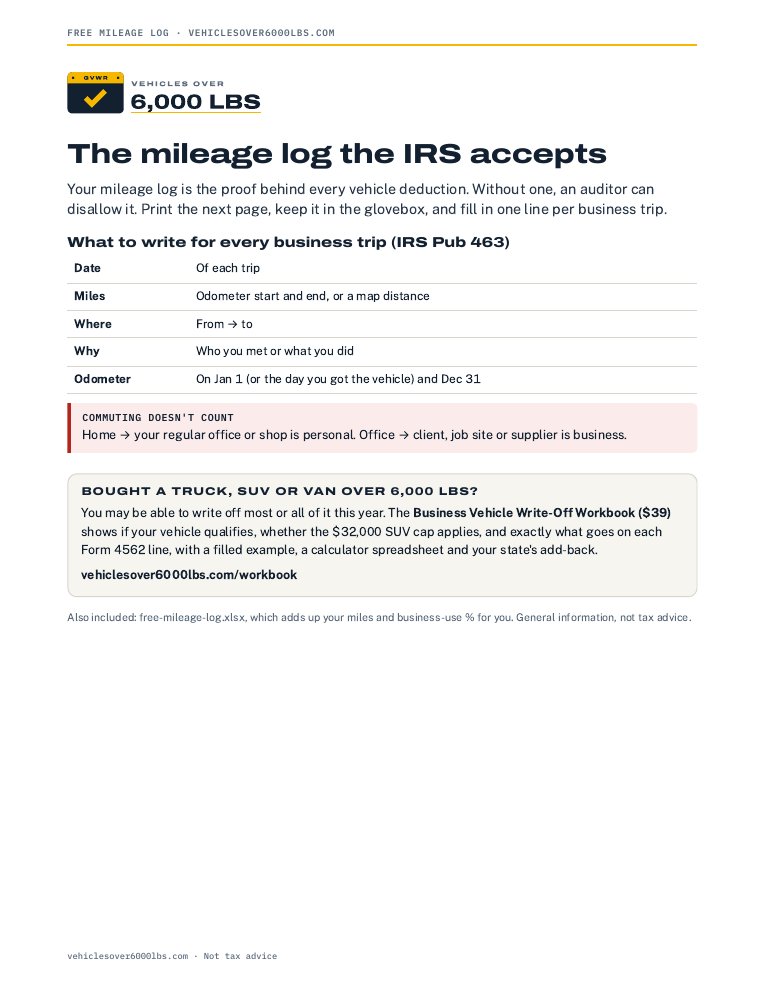
Printable log + spreadsheet. Dates on every trip, so you can apply the right rate, and your business-use % calculated for you.
Not announced yet (checked November 19, 2026). The IRS normally publishes next year's rate between mid and late December; the last five came out between December 14 and December 29. Until then the latest rate is 76 cents per business mile, in force since July 1, 2026. We update this page the day the IRS publishes.
Most likely in the second half of December 2026, by news release plus an IRS notice. Recent dates: Dec 29, 2025; Dec 19, 2024; Dec 14, 2023; Dec 29, 2022; Dec 17, 2021. The new rate applies to miles driven from January 1, 2027.
Not announced yet; it comes out with the business rate in December. Today it's 23.5 cents (since July 1, 2026), for medical travel and for moves by active-duty Armed Forces members. The charity rate stays at 14 cents, set by law.
Two rates. 72.5 cents per business mile for January 1 to June 30, 2026 (Notice 2026-10), and 76 cents for July 1 to December 31, 2026 (Announcement 2026-11). Medical and military moving: 20.5 cents, then 23.5 cents. Charity: 14 cents all year.
Probably, but it isn't certain. The trend since 2021 is up about 2–3 cents a year, and 2026 already rose mid-year to 76¢. Our estimate is 76–79¢; it fell in 2020 and 2021, so a flat or lower rate is possible if fuel prices drop.
The 2026 rates, not the 2027 ones. 2026 has two: 72.5¢ for business miles driven January 1 to June 30, and 76¢ for July 1 to December 31. Your mileage log needs dates so you can split the miles. The 2027 rate is for miles you drive in 2027, which go on the return you file in 2028.
Yes. Weight doesn't block it. What blocks it: having claimed Section 179, bonus depreciation or accelerated (MACRS) depreciation on that vehicle, running five or more vehicles at the same time, or not choosing the mileage rate in the first year you used the vehicle for business.
For a new vehicle over 6,000 lbs used over 50% for business, writing it off usually wins year one by a wide margin: an $80,000 SUV at 90% business use can deduct $72,000 in year one, versus about $11,138 for 15,000 miles at the 2026 rates. The mileage rate can win for an older, cheaper or high-mileage vehicle, or if business use is 50% or less. Decide in year one: once you take Section 179 or bonus on a vehicle, you can't switch it to the mileage rate later.
Yes. It replaces gas, oil, repairs, tires, insurance, registration and depreciation. You can still deduct business parking and tolls on top. If you're self-employed, the business share of car-loan interest and of personal property tax on the vehicle is deductible separately.
Not on their federal return: unreimbursed employee travel isn't deductible as an itemized deduction (with narrow exceptions such as Armed Forces reservists, fee-basis officials, some performing artists and eligible educators). Employers can reimburse mileage tax-free up to the IRS rate under an accountable plan.
Congress fixed it in the tax code (section 170(i)), so the IRS can't adjust it each year the way it does the business and medical rates. It has been 14 cents since 1998.
Most owners get the deduction wrong in one of three places: no mileage log, the wrong Form 4562 line, or a missed state add-back. Pick your next step.
Instant download · Refund any time until April 15, 2027 · See everything in the kit