Before you start: 5 facts you need
- Cost (price plus sales tax, fees; minus trade-in rules your CPA applies)
- Date placed in service (delivery date, not order date)
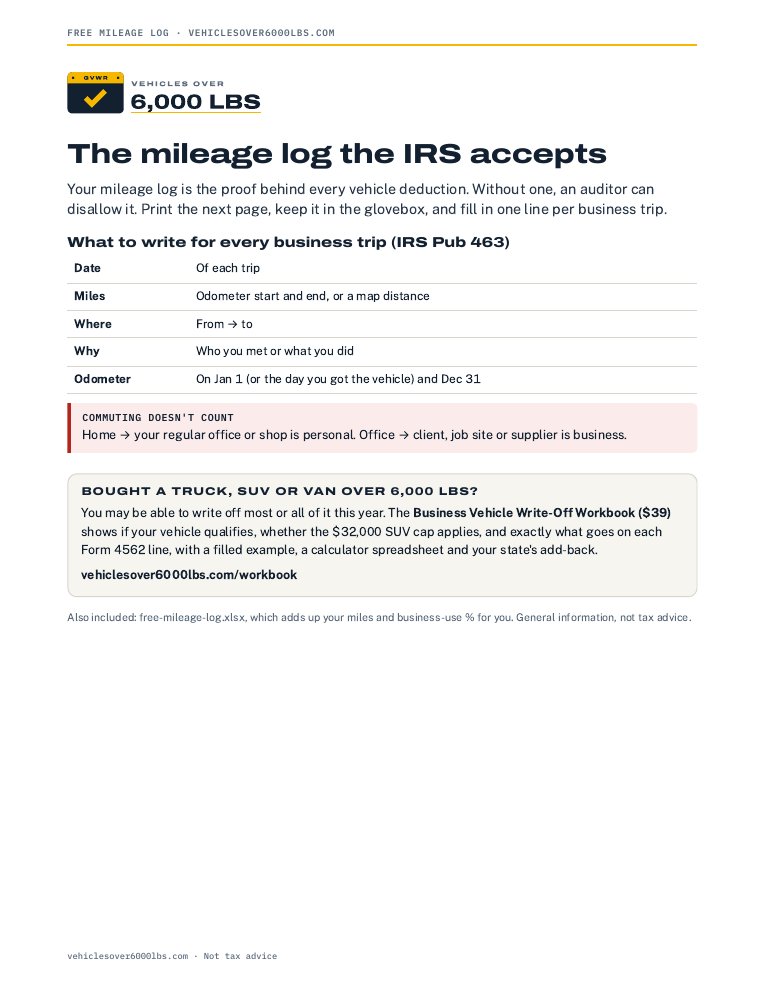
- Business-use % from your mileage log: business miles ÷ total miles
- GVWR from the door label (over 6,000 lbs?) and, for pickups, the bed length
- Business income for the year (Section 179 can't exceed it)
Example 1: $75,000 pickup, 6.5 ft bed, 85% business use
Delivered December 5, 2026. Business income $120,000. A 6.5 ft bed means no SUV cap, so the owner elects Section 179 for the whole business-use cost: $75,000 × 85% = $63,750.
Part V, Section A: listed propertyVehicle row
24aDo you have evidence to support the business use claimed?Yes
24bIf “Yes,” is the evidence written?Yes
25Special depreciation allowance (bonus) for listed property used over 50%$0
26 (a)Type of propertyDescribe it: year, make, model2026 pickup
26 (b)Date placed in service12/05/2026
26 (c)Business/investment use %85%
26 (d)Cost or other basis$75,000
26 (e)Basis for depreciation(d) × (c), minus Section 179 and bonus$0
26 (f)–(g)Recovery period / method-convention5 yrs · 200DB-HY
26 (h)Depreciation deduction$0
26 (i)Elected Section 179 cost$63,750
28Add column (h) lines 25 to 27, and Line 25 → carries to Line 21$0
29Add column (i) line 26 → carries to Line 7$63,750
Part I: Section 179Limits applied here
1Maximum amount (2026)$2,560,000
2Total cost of Section 179 property placed in service$63,750
3Threshold cost before reduction$4,090,000
4Reduction (line 2 minus line 3, not below zero)$0
5Dollar limit for the year$2,560,000
7Listed property: amount from Line 29$63,750
8Total elected cost (lines 6 + 7)$63,750
9Tentative deduction (smaller of line 5 or 8)$63,750
11Business income limitation$120,000
12Section 179 expense deduction$63,750
Part V, Section B: vehicle questionsFrom your mileage log
30Total business miles driven during the year3,400
31Total commuting miles0
32Total other personal (noncommuting) miles600
33Total miles (30 + 31 + 32)4,000
34–36Available for personal use off-duty? Used mostly by a 5%+ owner? Another vehicle available for personal use?Yes / Yes / Yes
December delivery means few miles in year one: 3,400 ÷ 4,000 = 85%. The % on Line 26(c) must match these miles.
Part IV: summaryGoes to Schedule C
12Section 179 from Part I$63,750
21Listed property from Line 28$0
22Total depreciation → Schedule C, line 13$63,750
Example 2: $80,000 SUV, 90% business use (SUV cap + bonus)
Business-use cost: $80,000 × 90% = $72,000. Section 179 is capped at $32,000 for an SUV, so the rest goes to 100% bonus on Line 25.
The lines that changeSUV over 6,000 lbs
25Bonus for listed property: $72,000 − $32,000$40,000
26 (c)Business/investment use %90%
26 (d)Cost or other basis$80,000
26 (e)Basis for depreciation: $72,000 − $32,000 − $40,000$0
26 (i)Elected Section 179 cost (SUV cap)$32,000
28 → 21Column (h) total incl. Line 25$40,000
29 → 7 → 12Section 179$32,000
22Total: $32,000 + $40,000$72,000
The 4 mistakes that cost owners the deduction
- Vehicle in Part II and Part V. Double-counted. It belongs in Part V only.
- No written evidence (Line 24b = No). You're telling the IRS you can't prove business use. Start a mileage log.
- Business-use % that doesn't match Lines 30 to 33. The miles must support the %.
- SUV cap ignored. Line 26(i) over $32,000 on an SUV or short-bed pickup is an error. Who the cap applies to.
Using the standard mileage rate instead? Then there's no depreciation to enter for the vehicle; the rate already includes it. Current IRS mileage rates and the 2027 status →
Your state return may need its own version of these numbers. Check your state's rules →